

Wednesday, November 19, 2025
12-1:30pm
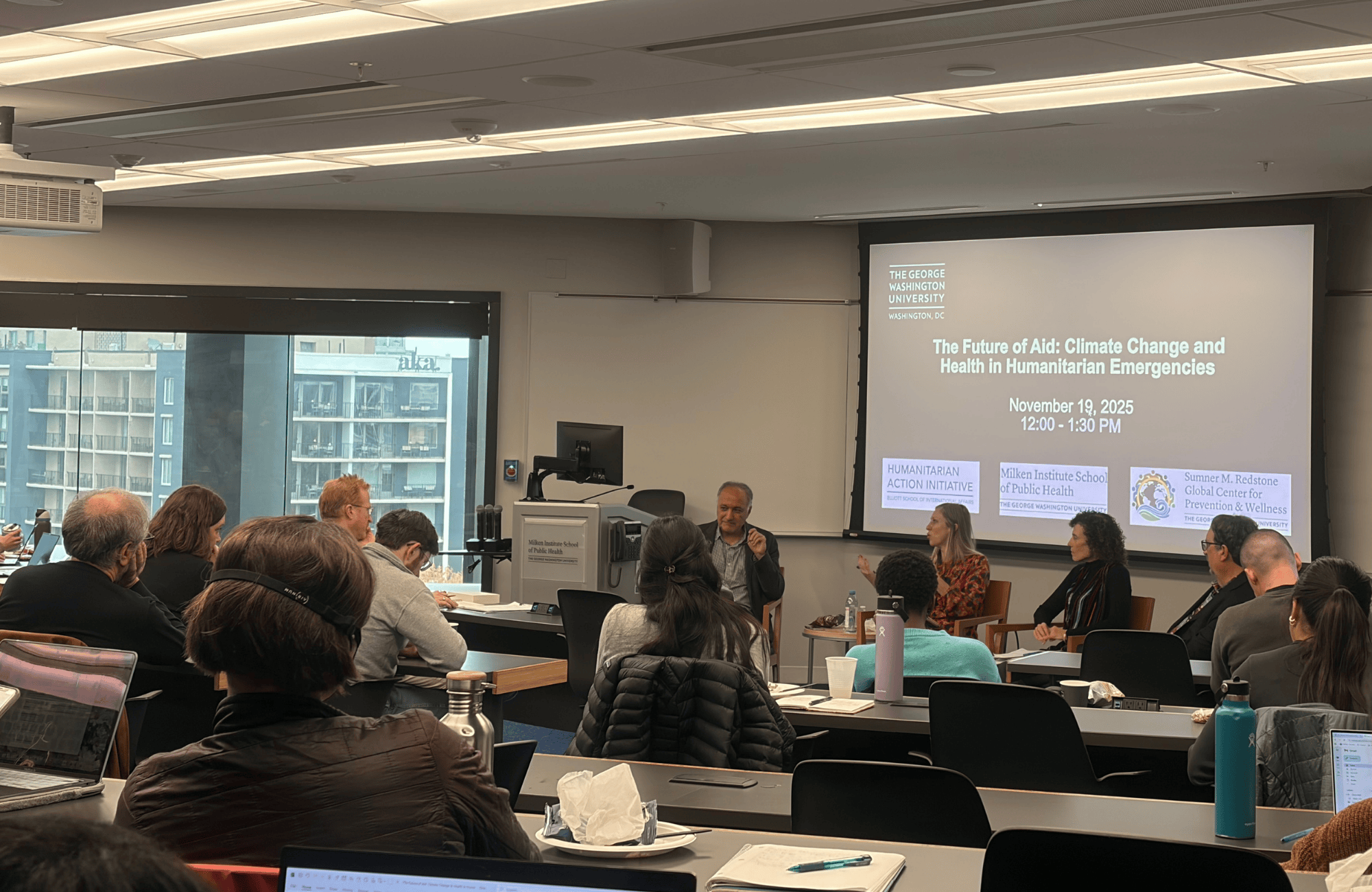
On November 19, 2025, the Redstone Global Center for Prevention and Wellness co-hosted a panel discussion on Climate Change and Health in Humanitarian Emergencies at the GW Milken Institute School of Public Health (GWSPH). This event was a collaboration with the Humanitarian Action Initiative at the Elliott School of International Affairs as part of their University Seminar Series on the Future of Aid. Over 50 students, faculty and staff attended from across the university and the wider D.C. community. Ramin Asgary, Professor of Global Health and Medicine and Director of Humanitarian Health and Disaster Response Program at GWSPH, moderated the discussion with seasoned humanitarian practitioners with ground-level and headquarters experience. Panelists included Colleen Gallagher Thomas from Relief International, Andrea Patterson from GOAL, and Dennis King, retired from the U.S. Department of State and UN agencies.
Panelists described the current humanitarian landscape as a polycrisis of climate hazards, conflict, economic instability, and other factors driving displacement and its associated health consequences. The effects of heat on maternal health and flooding on water, sanitation and hygiene conditions were mentioned as humanitarian health concerns. However, panelists emphasized that a systems approach is needed to address multiple, co-occurring hazards rather than focusing on one issue. This approach involves running simulations through health systems to identify gaps and identify innovative and locally appropriate solutions to sustainably enhance system resiliency to climate shocks and stressors.
In addition to systems-level approaches, the panelists emphasized the importance of coordination across the global humanitarian system, including with local actors, the private sector, academia, and multilateral agencies. Localization emerged as a key theme, including recognition of local knowledge for adaptation, building trust with local leaders, and providing tools and accompaniment to local actors for greater empowerment to address community-identified needs. In terms of global humanitarian coordination, panelists noted an opportunity with the upcoming UN “humanitarian reset” to make substantive changes at all levels to streamline efforts and reduced inefficiencies, such as parallel programs. The panelists highlighted that academia and the private sector can drive innovative solutions and policy-relevant evidence to address gaps in adaptation to climate change. Examples included partnering with local universities to enhance their research capacity; investigating the co-benefits of mitigation solutions, such as solar panels for health facilities; and improving access to cost-effective interventions, like rapid diagnostic tests and early warning systems.
As key takeaways, the panelists emphasized the importance of two-way communication with affected communities; taking an evidence-based, systems approach for greater efficiency and anticipatory action; and restructuring humanitarian systems to improve decision-making at the ground, program, and strategic levels.